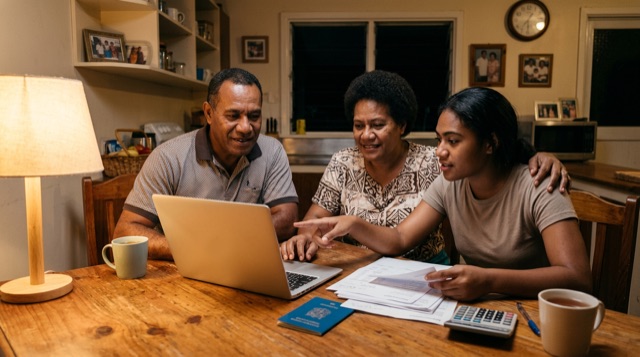
The Department of Home Affairs asks every student visa (subclass 500) applicant for the same core evidence: a passport, English, money, a Confirmation of Enrolment (CoE) and Overseas Student Health Cover (OSHC).1 The Department’s Document Checklist Tool, last updated 26 October 2026, sets the final list for each passport and education provider.2 This guide sorts the documents into the five groups the Studyaway Document List Generator uses.
Where does the student visa document list come from?
The Department of Home Affairs’ Document Checklist Tool takes the country of passport and the education provider, then lists the evidence to attach.2 The Department updates the tool on 31 March and 30 September each year, and at other times. Check the list again just before lodgement.1
The Department of Home Affairs requires evidence of financial capacity with the application whenever the checklist lists it. In the Department's words, "we may refuse your application without asking you for more information" if it is missing.1
For a package of courses, such as an English course (ELICOS) followed by a diploma, the last course is the main course. The Department uses the main course to set the English and funds evidence.1
The Studyaway Document List Generator asks the passport country, the relationship and seven yes or no questions, such as children and who pays. It then shows the list in five groups, with tick boxes that stay on the device, and can email the list.3
- Identity and school papersPassport, birth certificate, school certificates and every qualification since school.
- English testA test the Department approves, sat at a test centre within the 2 years before lodging.
- Evidence of moneyBank deposits, a loan or a scholarship, with statements that show where the money came from.
- CoE and OSHCStudyaway arranges the Confirmation of Enrolment and the health cover once the course is chosen.
- Genuine Student answers and lodgementWritten in the online form, up to 150 words each, with the documents above as evidence.
Sources: Department of Home Affairs, Student visa (subclass 500) page; Studyaway Document List Generator. Read 2 November 2026.
Everyone: the documents every student gathers
- Passport. The pages with the photo, personal details, and the issue and expiry dates. The passport must be valid when the application is lodged.1
- Birth certificate or birth extract. Studyaway asks every student for it.3
- High school certificate and results. The Department encourages evidence of previous study with the Genuine Student answers: transcripts, certificates and the length of each course.4
- Every qualification since high school. The certificate and the academic transcript for each course, finished or not.4
- CV or résumé. Every year since high school with no gaps: study, work and the time in between, with dates.3
- English test result, or proof of an exemption. A test the Department approves, taken within the 2 years before lodging, at a test centre. Fully online or at-home tests are not accepted. A passport from the UK, the USA, Canada, New Zealand or Ireland is an exemption.1
- Evidence of money. Deposits with a financial institution, a government loan or a loan from a financial institution, or a scholarship.1
- Bank statements that show where the money came from. Recent transaction statements that show how the money built up, such as regular salary payments. A bank balance certificate for a single day does not show this.1
Travel, the first 12 months of course fees, and living costs. The living costs figure is AUD $29,710 for 12 months.5
The funds calculator works out the figure.
Depends on your life: documents some students need
- National identity card. A copy, if the country issues one.1
- Marriage certificate. For a de facto partner, evidence of at least 12 months together.1
- Divorce or separation papers. The divorce certificate or a legal separation agreement.1
- Children’s birth certificates. A birth certificate or the family book for each child, with the names of both parents.1
- Custody papers. A court order that shows who has the legal right to decide where each child lives.1
- Proof of a change of name. Change of name papers from the registry, or documents that show other names used.1
- Employment reference letters and payslips. The employer, the period, the position and a person who can confirm it, plus a tax return and any job offer for after the course.4
- Documents about who pays. If someone else pays: proof of the relationship, their identity documents and evidence of past support. If a loan pays: the terms, the full amount and proof the lender has paid it out.1
- Study record in Australia. Every course studied in Australia before, with transcripts.4
- English translations. A translator in Australia must be accredited by the National Accreditation Authority for Translators and Interpreters (NAATI). A translator outside Australia adds their name, address, phone number and qualifications, in English.1
Only if the Department asks: after the application is lodged
Every applicant declares any criminal charge or conviction in the form.6 After lodgement, the Department of Home Affairs may ask for:
- Police certificates. From each country the applicant lived in for at least 12 months in the past 10 years. A certificate is valid for 12 months from issue.6
- Form 80 or Form 1563. Form 80 Personal particulars for character assessment, or Form 1563 Statement of Character.6
- Health examinations. The Department gives a list of the examinations and a HAP ID for the booking. Outside Australia, a panel physician approved by the Department does them.7
- Biometrics. The Department allows 14 days from its request, and biometrics must be given before travel to Australia.1
- Polio vaccination certificate. For an applicant who travels from, or spent time in, one of the 18 countries the Department lists as at risk of polio.8
- Military service records. A military certificate or Form 1399 Declaration of Service, for anyone who served in armed forces.6
Comes later, through Studyaway
- Confirmation of Enrolment (CoE). The education provider issues one CoE for every course in the application. The CoE must be valid at lodgement and when the Department decides the visa.1
- Overseas Student Health Cover (OSHC). A policy from an approved Australian insurer for everyone in the application, for the whole stay.1
- Genuine Student answers. Written questions in the online form, answered in English, up to 150 words each, with supporting documents attached in ImmiAccount.4
Studyaway arranges the enrolment and the health cover with the student. The health insurance page explains how OSHC works.
Family members coming with you: only in some cases since 2 October 2026
Since 2 October 2026, most student visa applicants cannot include a partner or children. The exemptions are a PhD student, a student sponsored by Foreign Affairs or Defence, and a fully funded foreign government scholarship. A passport from one of the 13 Pacific Island countries and Timor-Leste, or from one of ten Southeast Asian countries, is the other.1 A family member’s application must be made at the same time and place as the student’s, combined with it.9 No family member can apply later as a subsequent entrant.1 The student visa page lists the countries. Where family can be included, the Department asks for:
- Partner documents. Identity documents, character documents and the marriage certificate, or evidence of the de facto relationship.1
- Form 1229 consent. For each child, consent from any parent not coming to Australia who has a legal right to decide where the child lives, with that parent’s signed identity document.1
- School enrolment. For each child aged 5 to 17, a letter from the school or the state education department with the enrolment details and the fees paid.1
- Extra funds. AUD $10,394 for a partner, AUD $4,449 for each child, and at least AUD $13,502 a year in school costs for each school-age child.5
A common question about student visa documents
Do the documents need to be certified?
No. The Department of Home Affairs asks for colour scans or photos of every document, with a multi-page document saved as one file.1
This article is general information only, not migration advice. Figures and rules were read at source on 2 November 2026 (the sources are listed below). In Australia, immigration assistance may only be provided by a registered migration agent or Australian legal practitioner - Studyaway provides all students with access to a Registered Migration Agent.
Sources
- Department of Home Affairs, Student visa (subclass 500) page (last updated 22 October 2026). Read 2 November 2026.
- Department of Home Affairs, Document Checklist Tool (last updated 26 October 2026). Read 2 November 2026.
- Studyaway, Document List Generator for the student visa. Read 2 November 2026.
- Department of Home Affairs, Genuine Student requirement page (last updated 24 September 2026). Read 2 November 2026.
- Migration Regulations 1994, Schedule 2, clause 500.214; LIN 19/198, section 6(2), Compilation No. 2 (10 May 2024). Read 2 November 2026.
- Department of Home Affairs, Character requirements for visas page (last updated 2 November 2026). Read 2 November 2026.
- Department of Home Affairs, Arrange your health examinations page (last updated 24 September 2026). Read 2 November 2026.
- Department of Home Affairs, Threats to public health page (last updated 24 September 2026). Read 2 November 2026.
- Migration Regulations 1994, Schedule 1, item 1222(3)(da) and (3)(e) (family members), Compilation No. 289 (2 October 2026). Read 2 November 2026.
Checked and updated 2 November 2026.