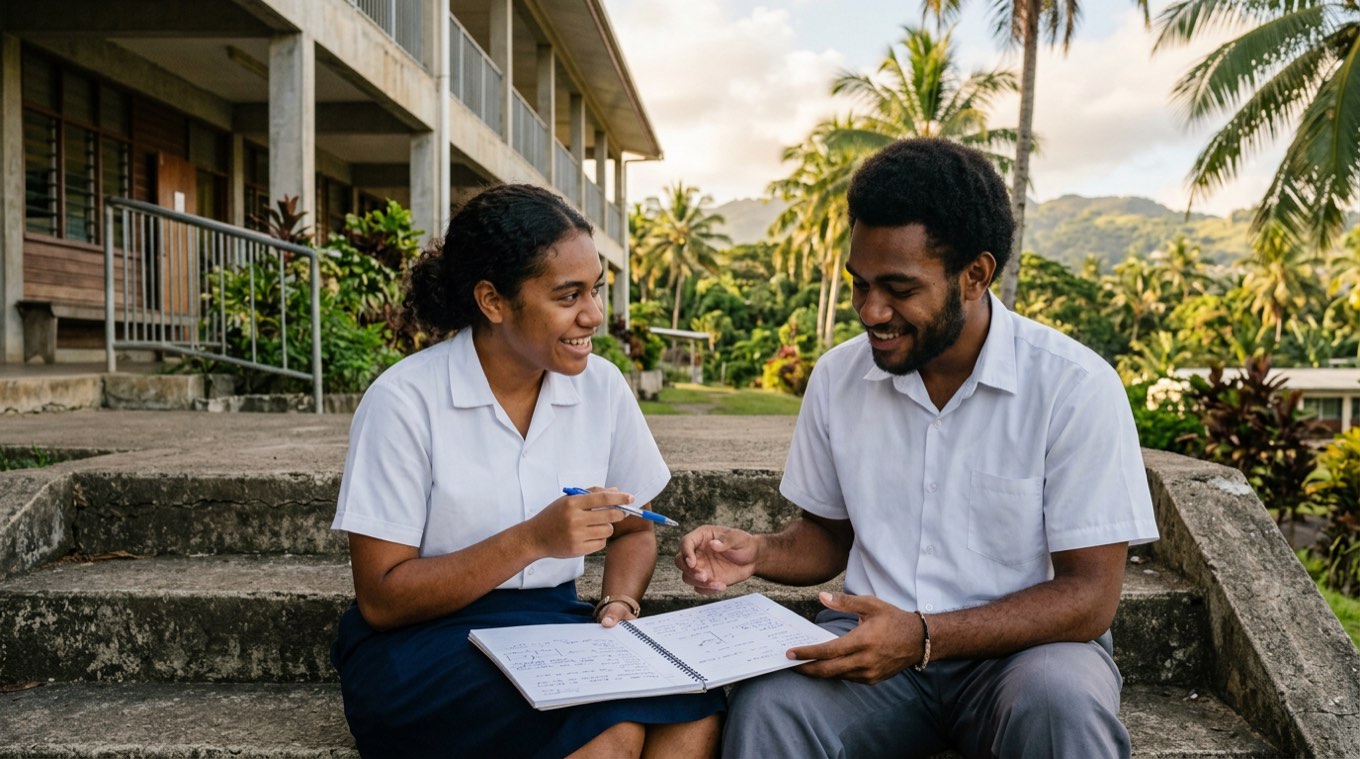
A student finishing Year 12 in Fiji chooses the career first, then the course that leads to it. The student visa (subclass 500) application charge on a Fiji passport is AUD $745.1 Since 2 October 2026 most students cannot include family, but a student with a Fiji passport may include a partner and children in the one application.1 The choice of course turns on three questions: can the student do the work, keep it up while studying in Australia, and does it lead where the student wants to go. Career Match answers the first two in 14 questions. The course pages answer the third.
Why does the career come before the course?
Career Match puts the career first and the course second. Two facts sit behind that order:
- The Department of Home Affairs asks why. The Genuine Student questions in the visa form ask why this course, with this provider, and how it benefits the applicant.2 A career chosen for a reason answers that question.
- The Department of Home Affairs requires evidence of AUD $29,710 in living costs for the first 12 months3, and the course runs for years. A career the student can do, in hours the student can keep, holds for all of it.
What do “PR Pathway” and “Employer Sponsored” mean on a course page?
Every course on the Studyaway course pages carries one of two labels.4 The label says what the route after study runs through.
| Employer Sponsored | PR Pathway | |
|---|---|---|
| What the label means | The route after study runs through an employer who sponsors the graduate. | The occupation has a pathway to permanent residency (PR) after study, through skilled visas. |
| On the course card | Employer-sponsored route | Pathway to PR |
Source: Studyaway course pages, read 2 November 2026.
Neither label promises an outcome. A pathway means the rules allow a route. Eligibility depends on the occupation, the employer and the student’s own situation.
On either route, the Temporary Graduate visa (subclass 485) is the visa many graduates apply for after study. The Department of Home Affairs requires the applicant to be 35 or younger.5
What does the Department of Home Affairs ask in the Genuine Student requirement?
The Department of Home Affairs asks written questions in the visa application form, up to 150 words each.2 The questions cover:
- Current circumstances: ties to family, community, employment and money at home.
- Why this course, in Australia, with this provider, and what the applicant knows about the course and about living in Australia.
- How completing the course benefits the applicant.
The Department gives more weight to answers supported by evidence.2 For a Year 12 leaver, that evidence is the school transcript and certificate, and the family’s circumstances in Fiji. Hoping to apply for permanent residence later does not count against an applicant. In the Department’s words, “future intentions of this kind do not count against an applicant”.2
What does a Fiji passport change?
The Department of Home Affairs counts Fiji as one of the 13 Pacific Island countries and Timor-Leste that it treats the same way.1 That sets three things.
The visa application charge
- AUD $2,500 for most applicants.
- AUD $2,050 for a passport from one of ten Southeast Asian countries on the Department’s list, or for an English-only (ELICOS) or non-award course.
- AUD $745 for a passport from Fiji or one of the other 12 Pacific Island countries and Timor-Leste on the Department’s list.1
Family can come
Since 2 October 2026, most student visa applicants cannot include family members.6 A student with a Fiji passport can. The Department of Home Affairs allows a partner and children to apply at the same time and place, in one application combined with the student’s.1 No family member can join later.6 Each person adds to the charge and to the funds:
- AUD $555 to the charge for a person 18 or over, AUD $185 for a person under 18.1
- AUD $10,394 in living costs for a partner, AUD $4,449 for each child, and at least AUD $13,502 a year in school costs for each school-age child.3
Where the application is made
A Year 12 leaver in Fiji applies from Fiji. The Department of Home Affairs requires the application to be made online, from outside Australia, with a valid Confirmation of Enrolment (CoE) and Overseas Student Health Cover (OSHC) in place.6
How much money does the Department ask to see?
- TravelThe fare from Fiji to Australia
- First-year course feesSet by the college, less any amount already paid
- AUD $29,710Living costs for 12 months
- Evidence of fundsFor the first 12 months in Australia
Source: Migration Regulations 1994, Schedule 2, clause 500.214; LIN 19/198, section 6(2), Compilation No. 2. Read 2 November 2026.
The Department of Home Affairs counts the first 12 months of course fees, so the course choice sets the figure.3 The fee is in the course guide. The funds calculator adds the three parts, and the family figures for a Fiji passport, and shows the total.
What English score does the student visa need?
For a test taken on or after 7 August 2025, the Department of Home Affairs sets the standard score at IELTS Academic 6.0 or PTE Academic 47.7 A lower score works with an English course first:
- IELTS 5.5 or PTE Academic 39, with at least 10 weeks of English Language Intensive Courses for Overseas Students (ELICOS) before the main course.
- IELTS 5.0 or PTE Academic 31, with at least 20 weeks of ELICOS.7
The test must fall within the 2 years before the application.7 The college may ask for a higher score than the visa does. The guide to the English score for an Australian student visa has the full table, and Study English shows how an English course and the main course sit on one visa.
Can a student from Fiji work while studying?
The student visa allows work of up to 48 hours a fortnight (every 2 weeks) while the course is in session, and no work before the course starts.8 The Department of Home Affairs calls AUD $29,710 the minimum for the visa, and says actual living costs may be much higher.6 In the Department’s words, a student “should not rely on work to support yourself or your family while in Australia”.6 Plan the money around savings and family support, with work on top.
Questions to ask before choosing a course
- The work: what the job does each day, and whether the student can do it for years.
- The hours: whether the course and 48 hours a fortnight (every 2 weeks) of work fit together.
- The label: PR Pathway or Employer Sponsored, and what the route after study runs through.
- The entry requirements: the English score and the Year 12 result the college asks for.
- The cost: the first-year fee in the course guide, AUD $29,710 in living costs and the AUD $745 charge.
- The reason: an answer to “why this course, with this provider” that fits in 150 words.
From Year 12 results to a CoE
- Choose the careerWhat you like and what you are good at, before any course name.
- Career Match14 questions. The result names one or two careers and the course for each.
- The course guideStudyaway sends the guide for the course: what it covers, the entry requirements and the fees.
- The college's offerStudyaway sends the application to the college. The college sends a Letter of Offer.
- The CoEThe college issues the Confirmation of Enrolment (CoE) once the offer is accepted and the deposit is paid.
- The visa application, from FijiMade online from outside Australia with the CoE, the English result, evidence of funds, OSHC and the Genuine Student answers. AUD $745 on a Fiji passport.
Sources: Department of Home Affairs, Student visa (subclass 500) page (last updated 22 October 2026); Migration Regulations 1994, Schedule 1, item 1222(2)(a)(ia), Compilation No. 289. Read 2 November 2026.
This article is general information only, not migration advice. Figures and rules were read at source on 2 November 2026 (the sources are listed below). In Australia, immigration assistance may only be provided by a registered migration agent or Australian legal practitioner - Studyaway provides all students with access to a Registered Migration Agent.
Sources
- Migration Regulations 1994, Schedule 1, item 1222(2)(a)(ia), (3)(da)(i) and (3)(e) (the visa application charge and family members on a Pacific-regional passport), Compilation No. 289 (2 October 2026). Read 2 November 2026.
- Department of Home Affairs, Genuine Student requirement page (last updated 24 September 2026). Read 2 November 2026.
- Migration Regulations 1994, Schedule 2, clause 500.214; LIN 19/198, section 6(2), Compilation No. 2 (10 May 2024). Read 2 November 2026.
- Studyaway course pages, read 2 November 2026.
- Migration Regulations 1994, Schedule 1, item 1229(4)(b) (Temporary Graduate visa age), Compilation No. 289 (2 October 2026). Read 2 November 2026.
- Department of Home Affairs, Student visa (subclass 500) page (last updated 22 October 2026). Read 2 November 2026.
- Migration Regulations 1994, Schedule 2, clause 500.213; LIN 25/090, sections 6 and 7 and Schedule 1 (in force 7 August 2025). Read 2 November 2026.
- Migration Regulations 1994, Schedule 8, condition 8105 (48 hours a fortnight), Compilation No. 289 (2 October 2026). Read 2 November 2026.
Checked and updated 2 November 2026.